Skip to content
  • Services
    • Speech & Feeding and Lactation Services
    • Insurance vs Self-Pay FAQs
    • Does My Plan Cover Speech Therapy?
  • About Us
  • Testimonials
  • SITC BLOG
    • SPEECH
    • FEEDING
    • AAC
    • Orofacial Myology
    • ASSISTIVE TECHNOLOGY
    • LANGUAGE
    • Practice News
    • ESPAÑOL
  • Resources
    • Client Login
    • ADVOCACY
    • Boom Store
    • TPT Store
    • Podcasts & Interviews
    • Therapy Resources
    • Employment
  • Contact
  • Services
    • Speech & Feeding and Lactation Services
    • Insurance vs Self-Pay FAQs
    • Does My Plan Cover Speech Therapy?
  • About Us
  • Testimonials
  • custom-logo
  • SITC BLOG
    • SPEECH
    • FEEDING
    • AAC
    • Orofacial Myology
    • ASSISTIVE TECHNOLOGY
    • LANGUAGE
    • Practice News
    • ESPAÑOL
  • Resources
    • Client Login
    • ADVOCACY
    • Boom Store
    • TPT Store
    • Podcasts & Interviews
    • Therapy Resources
    • Employment
  • Contact
Symbol Use and Transitioning CVI Stages
AAC

Symbol Use and Transitioning CVI Stages

May 19, 2020May 26, 2020 Leave a comment

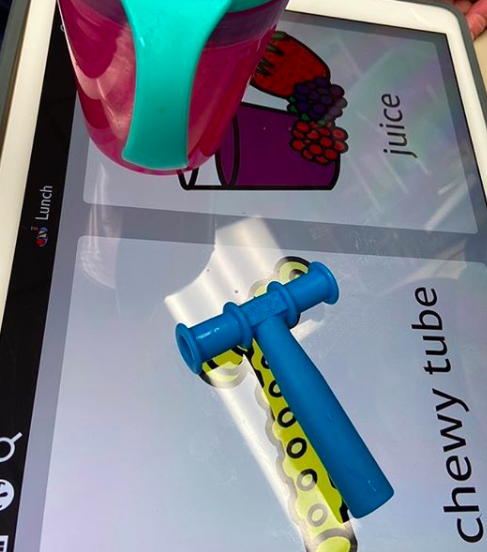
This little one is transitioning through CVI stages. ⁣
⁣
We are moving out of tangible and concrete items and onto a screen. The first step in doing this is providing a voice output underneath the item. You can either use a voice output switch or some sort of device. ⁣
⁣
Before I do any motor planning or set up any sort of communication system I need to first teach the child that there will be a new way to access communication messages through a screen. ⁣
⁣
What you are seeing here is modified snap plus core first with the actual items on top. I made it extremely big and provided her such a broad area to make sure that as soon as she grabs or touch the bottom of the item the voice output would go off. ⁣
⁣
Next I remove the items and she activated the areas where the items ones were. Again this is step one, we are just learning that there is a new access method for communication. Step two Is to then introduce more items and words, followed by setting up a robust communication system. 

AACcore wordsCVIvision impairment

Related Posts

Common AAC Misconceptions
Too Young for AAC?
Too Young for AAC?
An Idea for Emergent Speakers using a Predictable Line Method
Using Predictable Lines and Repeated Lines for Emerging Communicators

Post navigation

The Best Practice For Teaching Vocabulary
Too Young for AAC?
Hey, There!

Hey, There!

Welcome from Rebecca
Welcome to Speech in The City's blog. Here you'll find out lots of resources to help you or your child in speech and/or feeding therapy. We are always looking for new families to meet and professionals to learn from -Rebecca

CATEGORIES

  • AAC
  • ADVOCACY
  • ASSISTIVE TECHNOLOGY
  • ESPAÑOL
  • FEEDING
  • LANGUAGE
  • ORAL MOTOR
  • Orofacial Myology
  • Podcasts and Interviews
  • Practice News
  • SPEECH
  • Testimonials
  • Therapy Resources

Join Us

Get the latest speech news, home therapy ideas and practice updates.

More Posts

Dental Development and Facial Growth
ORAL MOTOR ➤ May 18, 2026

Dental Development and Facial Growth

Dental development plays an important role in a child’s speech, feeding, breathing, and overall oral facial growth. During childhood, clinicians may observe various dental patterns such as open bites, overbites, underbites, crossbites, crowded teeth, spacing...

Read More
Screening for Tonsillitis in Speech Therapy
Orofacial Myology ➤ May 4, 2026

Screening for Tonsillitis in Speech Therapy

When working with children in speech and feeding therapy, it is important to recognize when something medical may be impacting progress. Tonsillitis is one of those conditions. While speech language pathologists do not diagnose tonsillitis,...

Read More
Feeding Cues
FEEDING ➤ October 20, 2025

Feeding Cues

It seems like one of the most common questions I hear from families—no matter where they are in their child’s eating journey—is some version of:“Why won’t my child eat?” “Why won’t they eat more?” or...

Read More

Instagram

  • Contact
  • Client Login
  • Employment
  • Newsletter
  • Accessibility
© 2026 | Made in New York City